Is my eCommerce website accessible?
How to check if your eCommerce website is passing accessibility requirements
In June 2025, the European Accessibility Act (2025) came into effect, and with it, the requirements on businesses creating accessible websites became not only the morally right thing to do, but legally essential.
Why is it important?
The European Accessibility Act 2025 came into law last year to work alongside the UK’s Equality Act 2010, which prohibited discrimination against any one group from accessing a service, but as it was difficult to enforce, it meant that lots of websites were missing the mark. So that's where the European Accessibility Act came in.
Businesses now have a legal obligation to create and maintain accessible websites for their customers.
In the UK, 24% of the population live with a disability. That's around 13,670,000 people, and across Europe this increases to 27% of the population, with around 87,000,000.
The spending power of these customers and their households is commonly known as the Purple Pound. In the UK, this market is worth an estimated £274 billion a year. (scope.co.uk)
This makes the financial argument for creating accessible websites a no-brainer. Whether a business sees it as the carrot or the stick, making your site accessible is now essential.
How do I check if my website is accessible?
Here at Wind & Kite, we use WAVE extension tools to check that every website we build is accessible to all, and all our developers are trained in accessibility standards and practices.
But anyone can check their own website and see how it stands up.
Step One: Check your website
Using WAVE you can check any URL to get a real time report on where your website is doing well on accessibility and where it isn’t. You can also install this as an extension for your browser, such as Chrome or Safari.
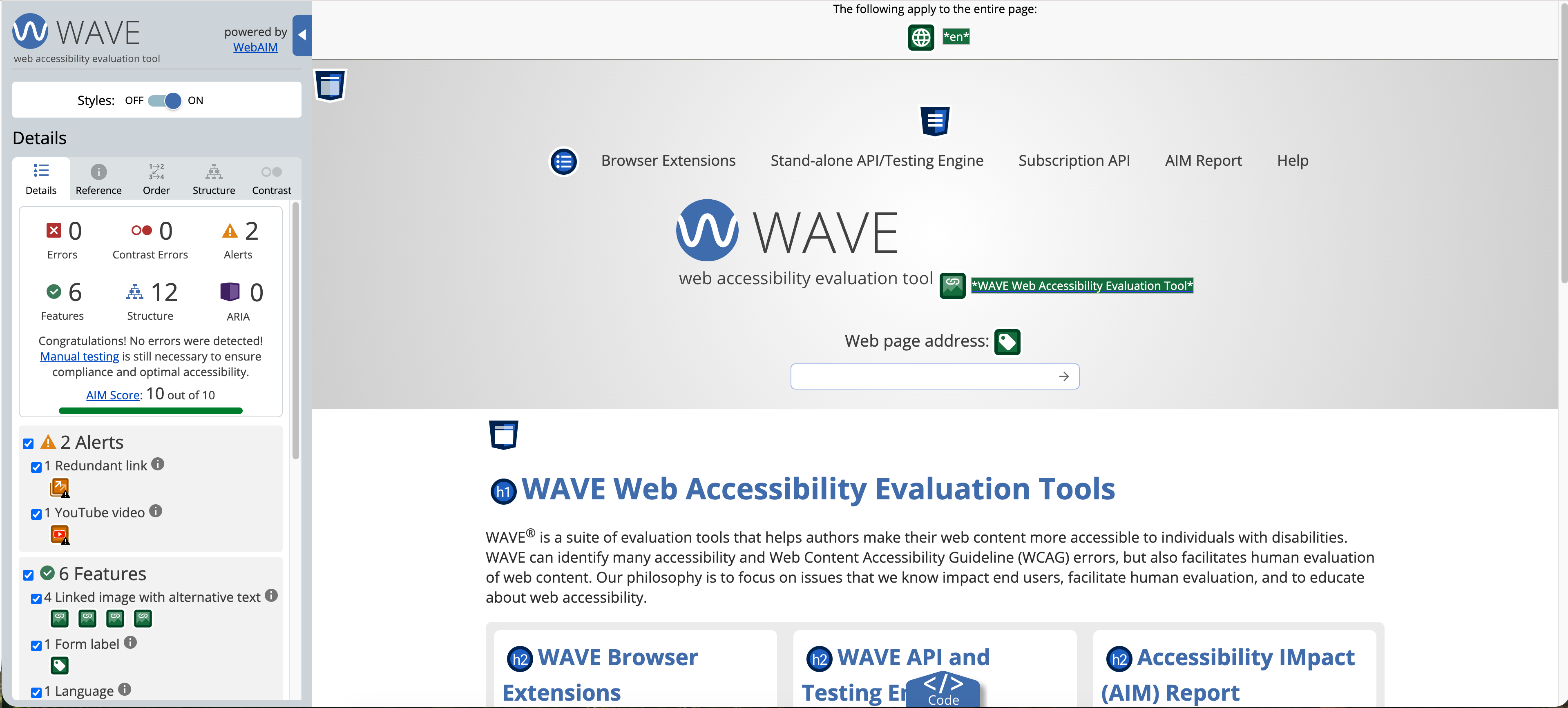
Remember this tool will only test the URL you are on; it can not search and test the entire website.
For best practice, we would recommend testing your home page, account pages, a Product Lister Page (PLP), and several Product Description Pages (PDP) to gain a generalised view of where your website sits and where you might need to improve.
Step Two: Check your Score
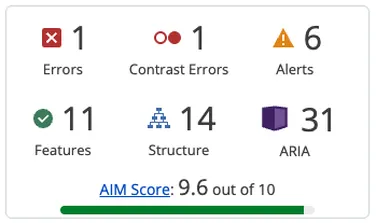
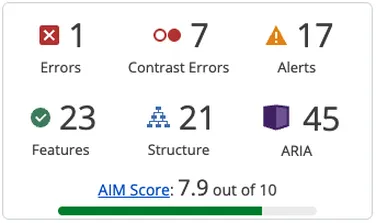
The WAVE Accessibility IMpact (AIM) score allows businesses to get a measure of how accessible their website is for users with disabilities.
The score is created based upon the number of detectable errors, the error density (how many there are) and the number of WAVE alerts present on a page to provide a score out of 10.
A score of 5 indicates that the page's score is roughly average compared to web pages generally. But obviously, the higher you score, the more accessible your page is.
Step Three: Understanding the Details
The summary will provide you with clear details of where you might be falling short, with clear error explanations on each section.
For example, you might be missing text (known as alt-text) to describe images or forms, which screen readers rely on to work.
Each section is clearly labelled and highlighted to take you through step by step.
Scope has created a brilliant guide for the basics of digital accessibility, and we would recommend familiarising yourself with the key details.
Now what?
So you have found your score, and you can see there are some areas for improvement. What do you actually need to do next to make your eCommerce website better?
Fix what you can yourself
Fix what you can on your own website first; many things can be fixed simply without the need for any external assistance. For example, image alt-text is often just a form field you can fill out yourself.
Ask your agency and developers to fix the problems wherever they can
It's important to have an accessible website, but if the list feels overwhelming, sit down with your development team to create an action plan.
Developers should help you work through the issues and define and scope what needs to be done to create a priority list of issues to ensure your website is accessible.
Go even further…
Have experts conduct an Accessibility Audit of your website
The gold standard of testing if your website is accessible should include a combination of automated, manual, and physical user testing. This should be used to benchmark your website against accessibility levels.
Here at Wind & Kite, we recommend Accessibility Services in partnership with Shaw Trust, as they do exactly this. If you would like to learn more, get in touch with us and and we can work with you to get this conversation started.
Don’t just check once
Future proof your site by conducting periodic revisits of your website’s accessibility standards.
The legislation will evolve, and there may be changes and extensions made to the law, which will need to be kept on top of.
It is the responsibility of the business to ensure that its eCommerce website is accessible to all users, and it should be periodically reviewed.
Educate yourself on Accessibility and how it affects users
We have spoken to people who live with disabilities and created several accessibility blogs trying to highlight the issues and how we can improve accessibility for everyone, but there is always more to learn.
Companies like the Shaw Trust and Scope also have resources available for businesses.
Partner with the right Agency
E-commerce businesses should partner with a web development agency that puts accessibility at the top of its priority list.
At Wind & Kite, we believe that making sites accessible isn’t just a legal requirement; it is morally the right thing to do.
Simply put, we believe that all websites should be accessible for everyone.
If you want to learn more about how Wind & Kite could improve your eCommerce site, get in touch with us below.